If you have any questions about the content on this page, or any other ecology based queries, click the button below, and a member of our team will be happy to help.
Get In Touch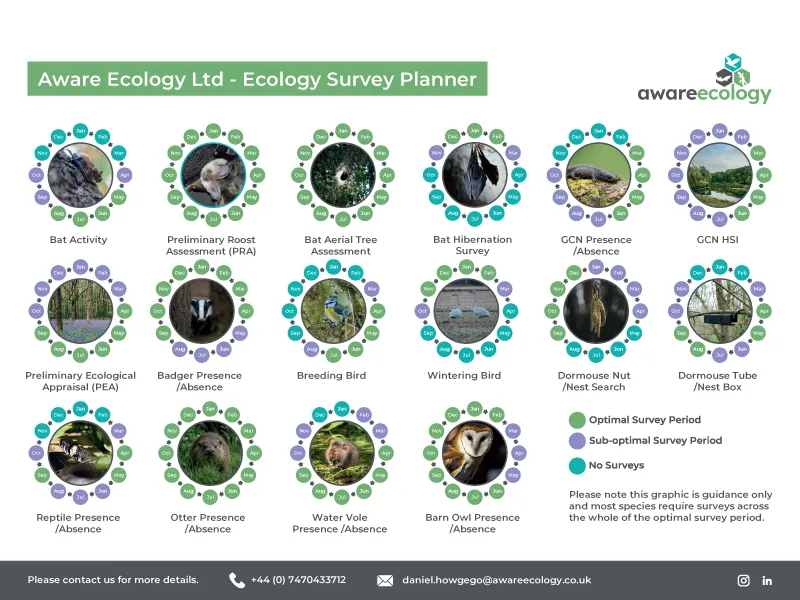
Badgers are protected in Britain under the ‘Protection of Badgers Act 1992’ and Schedule 6 of the ‘Wildlife and Countryside Act 1981’ (as amended).
The legislation affords protection to Badgers and Badger setts, and makes it a criminal offence to:
All 18 species of British bat are protected by The ‘Wildlife and Countryside Act 1981’ (as amended) extended by the ‘Countryside and Rights of Way Act 2000’ (CRoW Act). This legislation makes it an offence to:
Bats are also European Protected Species listed on Schedule 2 of the ‘Conservation of Habitats and Species Regulations 2017’ under Regulation 41. This legislation makes it an offence to:
All bat roosting sites receive legal protection even when bats are not present.
Where it is necessary to carry out an action that could result in an offence under the ‘Conservation of
Habitats and Species Regulations 2017’ it is possible to apply for a European Protected Species (EPS) licence from Natural England (NE). Three tests must be satisfied before this licence (to permit otherwise prohibited acts) can be issued:
All species of bird are protected under Section J of the ‘Wildlife and Countryside Act 1981’ (as amended). The protection was extended by the ‘CRoW Act’.
The legislation makes it an offence to intentionally:
Certain species of bird are listed on Schedule 1 of the ‘Wildlife and Countryside Act 1981’ (as amended) and receive protection under Sections 1(4) and 1(5) of the Act. The protection was extended by the ‘CRoW Act’. The legislation confers special penalties where the above-mentioned offences are committed for any such bird and also makes it an offence to intentionally or recklessly:
Great Crested Newt are listed on Schedule 5 of the ‘Wildlife and Countryside Act 1981’ (as amended), and receive full protection under Section 9. These species are also listed as European Protected Species on Schedule 2 of the ‘Conservation of Habitats and Species Regulations 2017’ which gives them full protection under Regulation 41. Protection was extended by the ‘CRoW Act’.
Under the above legislation, it is an offence to:
The Great Crested Newt is included as a Priority Species in the UK Biodiversity Action Plan (UKBAP) and also as a species of principal importance for the conservation of biological diversity in England under Section 74 of the ‘CRoW Act’.
The Dormouse is on Schedule 5 of the ‘Wildlife and Countryside Act 1981’ (as amended), and receives full protection under Section 9. This species is also listed as European Protected Species on Schedule 2 of the ‘Conservation of Habitats and Species Regulations 2017’, which gives them full protection under Regulation 41. Protection was extended by the ‘CRoW Act’.
Under the above legislation, it is an offence to:
The Dormouse is included as a Priority Species in the UK Biodiversity Action Plan (UKBAP) and also as a species of principal importance for the conservation of biological diversity in England under Section 74 of the ‘CRoW Act’.
Otters are on Schedule 5 of the ‘Wildlife and Countryside Act 1981’ (as amended), and receive full protection under Section 9. This species is also listed under the Conservation of Habitats and Species Regulations 2017 (as amended) and as a Species of Principle Importance (SPI) under the Natural Environment and Rural Communities Act (NERC) 2006.
The water vole is on Schedule 5 of the ‘Wildlife and Countryside Act 1981’ (as amended), and receives full protection under Section 9. This species is also listed as a Species of Principle Importance (SPI) under the Natural Environment and Rural Communities Act (NERC) 2006.
Therefore for both species, it is an offence to:
Common Lizards, Grass Snakes, Slow-worm and Adders are listed under Schedule 5 of the ‘Wildlife and Countryside Act 1981’ (as amended), in respect of Section 9(5) and part of Section 9(1). This protection was extended by the ‘CRoW Act’.
Under the above legislation, it is an offence to:
Sand lizards and Smooth snakes are designated as ‘European Protected Species’ under the EU Habitats Directive, which provides additional protection. This makes it an offence to deliberately or recklessly:
The cost will vary with factors such as location, project size and complexity and the number of surveys/surveyors required all playing their part in the total cost.
Please contact us and we will be able to provide further advice and a quote.
The cost will vary with factors such as location, project size and complexity and the number of surveys/surveyors required all playing their part in the total cost. Our costs for a PRA survey start from £350+VAT, following the PRA we will be able to discuss if further surveys are required and if so, the costs of these surveys.
Please contact us and we will be able to provide further advice and a quote.
The cost will vary with factors such as location, project size and complexity and the number of surveys/surveyors required all playing their part in the total cost.
Please contact us and we will be able to provide further advice and a quote.
The cost will vary with factors such as location, project size and complexity and the number of surveys/surveyors required all playing their part in the total cost.
Please contact us and we will be able to provide further advice and a quote.
The cost will vary with factors such as location, project size and complexity, number of waterbodies on site, and the number of surveys/surveyors required all playing their part in the total cost. Our HSI surveys start from £350+VAT, with follow up trapping/torching surveys for population assessment start from £1,799+VAT.
Please contact us and we will be able to provide further advice and a quote.
The cost will vary with factors such as location, project size and complexity and the number of surveys/surveyors required all playing their part in the total cost.
Please contact us and we will be able to provide further advice and a quote.
The cost will vary with factors such as location, project size and complexity all playing their part in the total cost. Our costs start from £399+VAT. Please contact us and we will be able to provide further advice and a quote.
Different bird species will nest in a variety of habitats, these may include hedgerows, trees, dense scrub or barns/old buildings. Whilst lakes, rivers and wetlands will commonly support schedule 1 species or overwintering birds.
Reptiles require a mix of habitat types to support their needs. This includes areas for basking (e.g. south facing slopes), hibernation (e.g. walls, piles of hardcore/wood) and foraging (e.g. rough grassland/scrub).
Should GCN be present on site then prior to the commencement of works a trapping and translocation scheme should be undertaken.
This consists of the construction of drift fencing around the site, along which a series of pitfall traps and refuge matting should be placed. These are then checked every morning for up to 90 days depending on the GCN population size. Any individuals trapped will be translocated to the pre-defined receptor site.
It is important to maintain the drift fencing for the entirety of the works to ensure GCN don’t re-enter the site.
It is a new scheme by Natural England to reduce the need for traditional mitigation licences. It allows suitable habitats and even individuals to be harmed, by ensuring the provision of suitable habitats off-site via a conservation payment. The aim of the scheme is to reduce the need for traditional, seasonal surveys and create a net gain for GCN at a landscape scale.
The areas that are covered by this scheme have been mapped by Natural England and will be maintained and monitored for 25 years.
Dormice generally use areas of dense woody vegetation. They are most likely to be found where there is a wide diversity of woody species contributing to three-dimensional habitat complexity, several food sources, plants suitable for nest-building material and that have good connectivity to other areas of suitable habitat.
First, a suitable receptor site must be identified, this may mean some enhancement such as refuge creation is required. Once the receptor site is set up artificial refugia is placed out on site and checked on a daily basis, and any reptiles seen are caught and moved to the receptor site.
Timeframes will depend on the population size on site.
Ideally, plans should be looked at with an aim of retaining suitable habitat, if this isn’t possible then mitigation will be required. This includes:
Otter surveys can be undertaken all year round as otters are always active. However, May to September is the optimum period due to water levels fluctuating less.
Water vole surveys should be undertaken from mid-April to June and with a second survey from July to September, as this covers the most active period for water vole.
Initial daytime surveys such as a Preliminary Roost Assessment (PRA) can be undertaken at any time of the year.
Following the initial visit we can advise you if any further surveys are necessary (e.g. activity surveys or bat emergence surveys), to fully establish the presence or absence of bats.
These follow on surveys are undertaken between May and August. Occasionally there is the ability for surveys to start earlier in the year, but this is weather dependent. Similarly, we can also survey well into September, but not where maternity roosts may be present, as most bats could have already dispersed.
Hibernation surveys should be undertaken in December, January and February.
Aerial tree surveys can be completed at any time throughout the year and are used to provide a recommendation for further surveys.
Explore our articles to learn more about our work, gain practical tips, and discover how you can support wildlife conservation efforts.